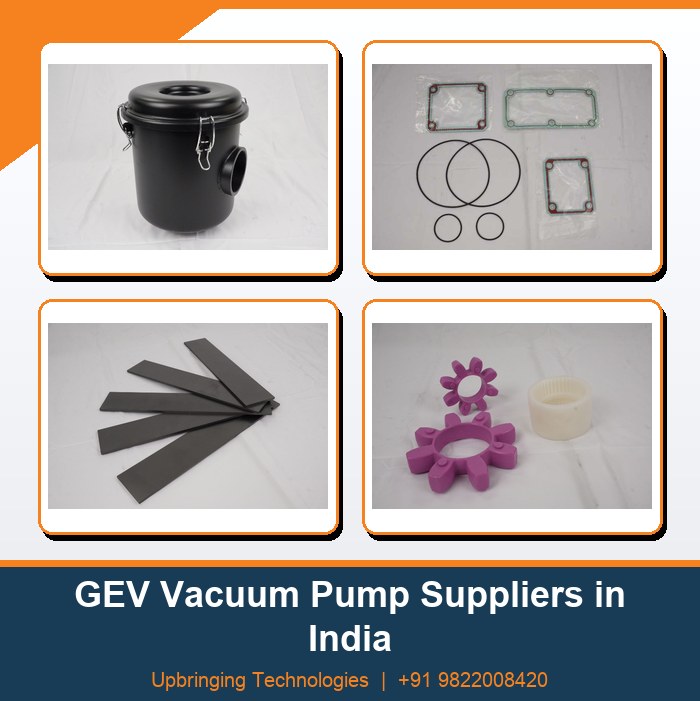


GEV Vacuum Pump Suppliers in India | Upbringing Technologies

GEV Vacuum Pump Suppliers in India
whatsapp-now
enquire-now

Upbringing Technologies is leading GEV Vacuum Pump Suppliers, Dealers, Distributors and Exporters in India. GEV vacuum pumps are used in industrial and process applications where controlled vacuum generation is required. They can support operations across manufacturing, packaging, food processing, chemical processing, laboratories, and automated equipment.

Different vacuum technologies are suitable for different operating requirements. Rotary, dry, oil-sealed, oil-free, and high-vacuum configurations can be selected according to required pressure, pumping speed, gas characteristics, duty cycle, and installation conditions.

Reliable performance also depends on proper maintenance. Regular inspection of filters, seals, vanes, rotors, valves, diaphragms, and other service components helps identify wear and maintain stable vacuum operation.

Types of GEV Vacuum Pumps

As we are leading GEV Vacuum Pump Suppliers in India, our Types are designed to meet different application requirements and industry standards, including the following types:

  • GEV Rotary Vane Vacuum Pump: This configuration uses rotating vanes to move gas through the pumping chamber. It can be suitable for general industrial applications requiring consistent vacuum generation.
  • GEV Rotary Vacuum Pump: Rotary technology uses mechanical rotation to continuously remove gas from a connected vacuum system. The appropriate configuration depends on the required vacuum range and operating conditions.
  • GEV Dry Vacuum Pump: A dry configuration operates without conventional oil entering the pumping chamber. It can be considered for applications where cleaner vacuum generation and reduced oil contamination are required.
  • GEV Oil Sealed Vacuum Pump: An oil-sealed configuration uses oil for lubrication and sealing within the pumping mechanism. It can provide reliable performance for applications compatible with oil-lubricated operation.
  • GEV Oil Free Vacuum Pump: An oil-free configuration is designed for processes where oil contamination should be minimized. Selection should consider the required pressure, gas load, temperature, and operating cycle.
  • GEV High Vacuum Pump: High-vacuum equipment is used when a process requires substantially reduced pressure. Proper selection should consider chamber volume, leakage rate, gas load, and required operating pressure.

Vacuum Pump System and Equipment

  • GEV Vacuum Pump System: A vacuum pump system can combine the pump with piping, valves, filters, gauges, controls, and other components required for a complete installation. Configuration depends on the application and process requirements.
  • GEV Vacuum Pump Unit: A vacuum pump unit is a complete pumping assembly designed for integration with machinery or process equipment. It can include the pump, drive, cooling arrangement, and associated components.
  • GEV Vacuum Pump Machine: A vacuum pump machine provides the equipment required to remove air or process gases from a connected chamber or system. Capacity should be selected according to the actual application.
  • GEV Vacuum Pump Equipment: Vacuum equipment includes pumping assemblies and supporting components used for generating, controlling, and maintaining vacuum. Correct sizing helps achieve the required operating conditions.
  • GEV Vacuum Pump Motor: The motor provides the mechanical power needed to operate the pumping mechanism. Motor power, voltage, speed, mounting arrangement, and duty conditions should be checked before selection.

Detailed Process Description

  • Step 1: Application Assessment: The application is reviewed according to required vacuum level, pumping speed, gas composition, chamber volume, operating temperature, and duty cycle.
  • Step 2: Pump Selection: The appropriate pumping technology is selected based on the application. Rotary, dry, oil-sealed, oil-free, and high-vacuum configurations have different operating characteristics.
  • Step 3: Installation: The pump is connected to the vacuum chamber or process equipment using suitable piping, valves, filters, and fittings. Proper sealing helps minimize unwanted air leakage.
  • Step 4: Gas Intake: During operation, gas enters the pump through the inlet connection. The pumping mechanism continuously removes gas from the connected system.
  • Step 5: Compression and Discharge: The internal pumping elements transport and compress the gas before directing it toward the exhaust side. Continuous gas removal reduces pressure inside the connected system.
  • Step 6: Performance Monitoring: The equipment is monitored for vacuum level, temperature, vibration, noise, leakage, and other operating conditions. Regular monitoring helps identify maintenance requirements.

Internal Components and Service Parts

As a trusted GEV Vacuum Pump Suppliers in India, we serve businesses across various industries that meet professional visual communication requirements.

Component Function Maintenance Consideration
GEV Vacuum Pump Parts Support equipment operation and servicing Match the pump model
GEV Vacuum Pump Spare Parts Replace worn or damaged elements Verify specifications
GEV Vacuum Pump Replacement Parts Restore specific components Check dimensions and compatibility
GEV Vacuum Pump Components Provide mechanical and sealing functions Match equipment configuration
GEV Vacuum Pump Rotor Supports gas movement in applicable designs Inspect wear and alignment
GEV Vacuum Pump Vanes Assist gas movement and internal sealing Check wear and condition
GEV Vacuum Pump Seals Help maintain vacuum integrity Verify material compatibility
GEV Vacuum Pump Seal Kit Provides multiple sealing elements Select according to model
GEV Vacuum Pump Gasket Seals mating surfaces Check size and material
GEV Vacuum Pump Diaphragm Moves gas in applicable diaphragm pumps Inspect for damage and fatigue

Filtration and Flow-Control Components

  • GEV Vacuum Pump Filter: A vacuum pump filter helps protect the equipment from particles and contaminants entering the pumping system. Regular inspection can help maintain effective operation.
  • GEV Vacuum Pump Oil Filter: An oil filter is used in applicable oil-lubricated systems to remove contaminants from circulating oil. Its condition should be checked during routine servicing.
  • GEV Vacuum Pump Exhaust Filter: An exhaust filter helps manage oil mist and other contaminants discharged from applicable pumps. Replacement requirements depend on operating conditions and filter loading.
  • GEV Vacuum Pump Inlet Filter: An inlet filter helps prevent dust and particles from entering through the suction side. Maintaining the filter can help protect internal components and support consistent airflow.
  • GEV Vacuum Pump Valve: A vacuum pump valve regulates or controls gas movement within suitable vacuum systems. The correct valve type depends on the pump and system configuration.
  • GEV Vacuum Pump Repair Kit: A repair kit contains selected service components required for maintenance or repair of a compatible pump. Contents vary according to the equipment model and service requirements.

Features and Benefits of GEV Vacuum Pumps

As GEV Vacuum Pump Suppliers in India, our products provide several Features and Benefits including consistent quality, smooth finish, and long service life.

Features Benefits
Multiple pump technologies Supports varied industrial requirements
Rotary configurations Suitable for general vacuum applications
Dry-running options Helps reduce oil contamination
Oil-sealed configurations Supports compatible industrial processes
Oil-free designs Suitable for cleaner process conditions
High-vacuum options Supports lower-pressure applications
Replaceable service components Simplifies maintenance
Filtration and valve options Helps protect and control the system

Applications of GEV Vacuum Pumps

As GEV Vacuum Pump Suppliers in India, our all types are used in various types of industrial sectors such as:

  • Packaging: Vacuum systems can support vacuum packing, forming, handling, and sealing operations. Proper pump selection helps maintain the required pressure conditions during production.
  • Food Processing: Vacuum equipment can be used for packaging, drying, conveying, and selected food processing operations. The pump should be compatible with the process environment and gas load.
  • Pharmaceutical Manufacturing: Vacuum generation supports selected drying, filtration, concentration, and processing applications. Equipment selection should consider process cleanliness and operating requirements.
  • Chemical Processing: Vacuum systems are used in processes such as evaporation, filtration, drying, and distillation. Pump materials and technology should be suitable for the gases and vapours involved.
  • Plastics Processing: Vacuum can be used for degassing, drying, forming, and material handling. Required pump capacity depends on the process load and operating conditions.
  • CNC and Machining: Vacuum systems support workholding, lifting, and material handling in machining operations. Correct equipment sizing helps provide consistent suction during machine operation.
  • Vacuum Furnaces: Vacuum pumps help reduce chamber pressure during heat treatment and other controlled processing operations. Selection depends on chamber volume, pressure requirements, and gas load.
  • Industrial Automation: Vacuum generation is used in robotic gripping, lifting, pick-and-place, and material handling systems. Reliable equipment helps maintain consistent automated operation.
  • Laboratory Systems: Laboratories use vacuum for drying, filtration, testing, coating, and research processes. Pump selection depends on required pressure, gas load, and process conditions.
  • Vacuum Conveying: Vacuum conveying systems use controlled suction to transport powders, granules, and other materials. Pump capacity should match conveying distance and material characteristics.

Why Choose Us?

As one of the leading GEV Vacuum Pump Suppliers in India, we deliver premium-quality solutions designed to meet diverse industrial requirements. Here's why we stand out:

  • Application-Based Selection: We evaluate vacuum level, pumping speed, gas characteristics, operating conditions, duty cycle, and installation requirements before recommending a suitable solution.
  • Component Support: We provide options for mechanical, sealing, filtration, valve, and repair requirements, helping customers maintain and service their vacuum equipment.
  • Technical Assistance: Our approach focuses on matching pump technology and components with actual process requirements. This helps avoid unsuitable equipment selection.
  • Maintenance Solutions: Timely inspection and replacement of worn service components can help maintain vacuum performance and reduce unexpected equipment downtime.
  • Industrial-Focused Solutions: We provide practical vacuum solutions for manufacturing and process applications, including complete equipment, replacement components, filtration products, and supporting accessories.

Choose Upbringing Technologies is leading GEV Vacuum Pump Suppliers, Dealers, Distributors and Exporters in India. Selecting suitable vacuum equipment requires careful evaluation of pressure requirements, pumping capacity, gas characteristics, operating conditions, and installation requirements. Different technologies provide different performance characteristics for specific industrial processes. Contact us with your pump model, application details, vacuum requirements, or component specifications to identify a suitable solution for your vacuum system.

FAQ’s

Common configurations include rotary vane, rotary, dry, oil-sealed, oil-free, and high-vacuum designs. The correct choice depends on the required vacuum level and process conditions.

Consider the required pressure, pumping speed, gas composition, gas load, chamber volume, operating cycle, temperature, and available installation space.

Replacement intervals depend on contamination, operating hours, pressure drop, process conditions, and the maintenance requirements applicable to the specific equipment.

Yes. Depending on the equipment condition, rotors, vanes, seals, gaskets, filters, valves, diaphragms, and other service components can often be replaced individually.

The pump model, serial information, component name, dimensions, application, operating conditions, and photographs of the existing component can help identify a suitable replacement.

Call Us
WhatsApp